Understanding What Drives Poway Home Values
May 7, 2026
May 7, 2026
If you own a home in Poway or hope to buy one, you have probably wondered why some properties draw stronger offers than others. In a market where prices are still high and buyers are choosy, small differences in lot utility, outdoor features, and location can have a real impact on value. Understanding those drivers can help you price more accurately, shop more confidently, and focus on the details that matter most. Let’s dive in.
Poway remains a high-price market, but it is not a market where every home performs the same. Zillow reports an average home value of $1,230,064, down 4.2% year over year, while Redfin shows a March 2026 median sale price of $1,236,750. Those are different measurements, but together they point to a similar price range.
The pace is still relatively quick. Zillow says homes go pending in about 12 days, and Redfin reports a median of 21 days on market. At the same time, homes sold for 98.8% of list price on average, 42.5% closed above list, and 36.4% had price drops.
That combination tells you something important. Poway is still competitive, but buyers are selective. A well-prepared property with the right features can stand out, while a home with drawbacks may need a price adjustment to attract offers.
Poway has a broad mix of housing, from multifamily properties to single-family homes on larger rural parcels. The city says 80% of housing units are single-family, and more than half of Poway’s 39.4 square miles is preserved as open space. That makes larger parcels feel more distinctive, especially when they offer flexibility.
Still, size alone does not guarantee a higher value. In Poway, what often matters more is whether the land is flat enough to enjoy, practical to maintain, and legally usable for the way a buyer wants to live. A smaller parcel with better layout and access can be more appealing than a larger lot that is steep or awkward.
City guidance shows that parcel size can affect how land may be used. For example, Poway’s large-animal guidance begins with a 10,000-square-foot minimum lot size, and allowed animal counts increase as parcel size grows. The city also notes that ADUs and JADUs may be possible depending on the lot and zoning.
That is why buyers often look beyond the acreage number. They may be asking whether there is room for outdoor entertaining, storage, RV or boat parking, horse use, or future improvements that fit city rules. In practice, usable and flexible land tends to draw more attention than raw square footage alone.
Recent public listing examples in Poway reinforce this pattern. Listings have highlighted features like a 0.6-acre horse property, detached office or studio space, mountain views, privacy, and room for an ADU, RV, or boat parking. That marketing language reflects what buyers are responding to in the local market.
For sellers, this means your lot’s story matters. If your property has a permitted use, a practical layout, or hard-to-find outdoor flexibility, those features may deserve more emphasis during pricing and marketing.
Poway’s outdoor identity plays a real role in how buyers see value. The city points to Lake Poway as a long-standing recreation destination with boating and fishing access. Blue Sky Ecological Reserve adds another layer with its 700-acre canyon setting and outdoor programs, and the community profile notes 78 miles of trails.
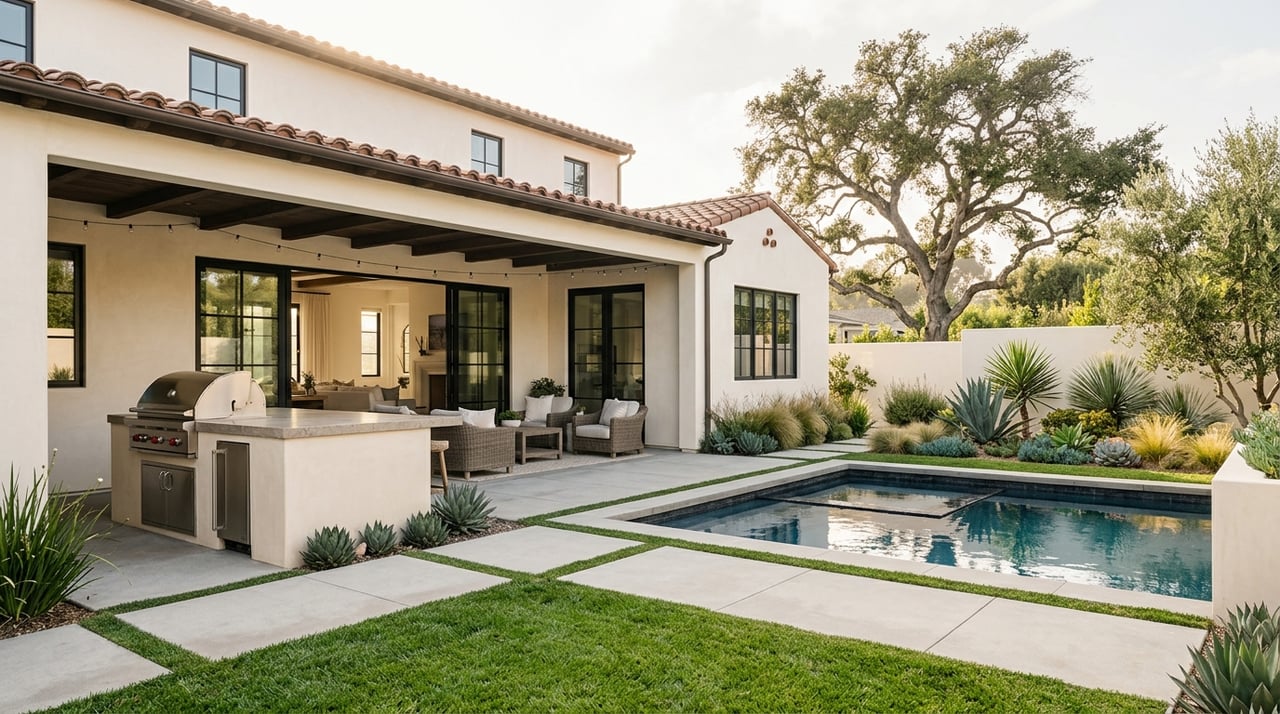
This helps explain why outdoor living features resonate here. Patios, pools, shade structures, low-maintenance landscaping, and finished entertaining areas fit the way many buyers want to use their homes. In a city known for recreation and open space, outdoor functionality can feel like an extension of the living area.
Poway’s climate supports outdoor use for much of the year. The city reports an average August high of 82°F and about 14 inches of annual rainfall. That makes comfortable outdoor spaces more practical than they might be in a less temperate setting.
Views can also matter. Poway’s rolling hills create view corridors across parts of the community, and buyers often respond to backyards that capture privacy, open-space outlooks, or hillside scenery. When those views are paired with usable land, the overall appeal can become much stronger.
Open space and scenic surroundings do not automatically raise value in every case. Poway also connects chaparral and open-space areas with wildfire hazard designations. So while a home near natural land may offer privacy or views, it can also come with more homeowner responsibilities.
That is why buyers tend to weigh the full picture. The setting may be attractive, but maintenance, defensible space, and construction requirements can also affect how a property is perceived.
Poway Unified School District is a meaningful part of the local demand story. The district operates 40 schools across Poway and San Diego, serves more than 34,000 students, and has 11 schools within Poway city limits. For many buyers, access to established public school options is one of several factors they consider when choosing where to live.
It is important to keep this in perspective. School access does not create a premium by itself, but it can help support steady interest from buyers comparing Poway to other parts of San Diego County.
Poway’s location adds another layer of value. The city profile places Poway about 3 miles east of Interstate 15 and just west of Highway 67, with San Diego International Airport roughly 24 miles south. That positioning helps many residents stay connected to employment centers and regional travel.
Convenience tends to matter more when the broader market slows down. Buyers may become more selective, but they still value homes that make daily routines simpler. Access, when combined with a strong property profile, can help a home stay competitive.
The city describes Poway’s business park as a major commercial area with more than 500 businesses and roughly 18,000 employees. A local employment base like that can support housing demand from people who work in Poway as well as nearby commuters.
This does not mean every home sees the same effect. But a stable job base is one reason Poway continues to attract attention even when prices soften from prior highs.
Wildfire exposure is one of the clearest factors that can shape value in Poway. The city notes that more than half of the community is preserved as open space, and hazardous fire areas were designated following the 2003 Cedar Fire and 2007 Witch Fire. Very High and High fire hazard zones can trigger ignition-resistant construction, defensible-space standards, and disclosure requirements.
For buyers, this can influence both comfort level and ongoing ownership expectations. For sellers, it means preparation matters. A home’s setting may be beautiful, but buyers will often look closely at how the property is maintained and whether the lot feels manageable.
The city also makes an important distinction: its hazard maps are intended to guide planning decisions, not insurance decisions. That is useful context for anyone comparing homes near open space or hillside areas.
If you are selling in Poway, the most valuable improvements are often the ones that make the property easier to enjoy and easier to understand. Well-kept landscaping, clear patio areas, safe fencing, and outdoor spaces with obvious purpose can strengthen how buyers respond to your home. The goal is to show not just size, but usability.
Documentation can help too. If your property has permitted advantages such as an ADU, JADU potential tied to zoning, or parcel-specific utility, that information may support stronger buyer confidence. In a selective market, clarity can be just as important as curb appeal.
Presentation also matters when price sensitivity increases. Since a notable share of Poway homes have had price drops, sellers benefit from positioning the home carefully from day one with strong visuals, a realistic price, and a clear explanation of what makes the property stand out.
If you are buying in Poway, it helps to look beyond surface-level comparisons. Two homes with similar square footage can offer very different long-term value depending on lot usability, outdoor function, privacy, and wildfire-related considerations. Asking better questions upfront can help you avoid overpaying for land you cannot fully use.
As you compare options, focus on practical details:
In a market like Poway, value is often tied to how well a home fits real life, not just how it looks on paper.
Poway home values are shaped by more than just square footage and recent sales. Market conditions, lot utility, outdoor living, access, local employment, and wildfire-related factors all play a role. The strongest premiums often appear when multiple strengths come together in one property.
That is why pricing and purchase decisions in Poway deserve a local, property-specific approach. If you want to understand how your home’s lot, features, and location may affect its value, or you want help evaluating the tradeoffs between Poway properties, Select Living Realty Group can help you make a more confident move.
Stay up to date on the latest real estate trends.




Your Late-Summer Real Estate Game Plan



Moving to San Diego Family Guide: Top Schools, Neighborhoods & Amenities


A Data-Driven Guide to Maximizing Your Net Proceeds
Select Living Realty Group isn’t just about transactions—it’s about building lifelong relationships. From negotiating the best deal to guiding you through every step, we are always in your corner.